KOGI STATE INVESTMENT PROMOTION & PUBLIC-PRIVATE PARTNERSHIP AGENCY PARTNER WITH AEC →  |  +234 (0) 803 000 0000
LAT 7.4956°N
LON 6.5482°E
UNOSI · AJAOKUTA · KOGI
A 4,000-Hectare Economic City

Where Africa forges its next chapter.

At the geographic heart of Nigeria — the only state bordering nine others — Ajaokuta Economic City turns iron ore, agricultural abundance and continental access into bankable industrial returns.
4,000ha
Master-Planned Land
$1.3bn
Project Capex
178%
20-Year Project ROI
9.3yrs
Estimated Payback
Scroll · The Renewal Begins
Steel & Mining Value Chain Agro-Processing Cluster Logistics & Multimodal Hub AfCFTA Gateway · 1.4Bn Consumers Itakpe–Warri Standard Gauge Rail River Niger Multimodal Access Tax Holiday · 100% Capital Repatriation Steel & Mining Value Chain Agro-Processing Cluster Logistics & Multimodal Hub AfCFTA Gateway · 1.4Bn Consumers Itakpe–Warri Standard Gauge Rail River Niger Multimodal Access Tax Holiday · 100% Capital Repatriation
The Proposition

A free zone shouldn't just host industry. It should summon it.

"We have earmarked 4,000 hectares not to copy what exists — but to build what Nigeria has needed for forty years: an integrated industrial city, anchored by steel, fed by the Niger, and connected to the continent." — Office of the Executive Governor, Kogi State

Nigeria is Africa's largest economy by GDP — and yet imports up to $65 billion of steel annually, depends on oil for 75% of exports, and produces less than a quarter of the steel it consumes. Kogi State holds one of the largest iron ore reserves on the continent. The Ajaokuta steel plant has stood incomplete for four decades. The Itakpe–Warri standard-gauge rail runs idle for want of cargo.

Ajaokuta Economic City is the deliberate, capital-efficient answer. Not another speculative free zone, but an integrated 4,000-hectare industrial city designed around real comparative advantage: steel, agro-processing, and inland logistics — sequenced through three phases with anchor-led infrastructure deployment.

We are now seeking a Master Developer, anchor industrial tenants, and Free Zone Enterprises to join the most strategically positioned greenfield industrial opportunity in West Africa.
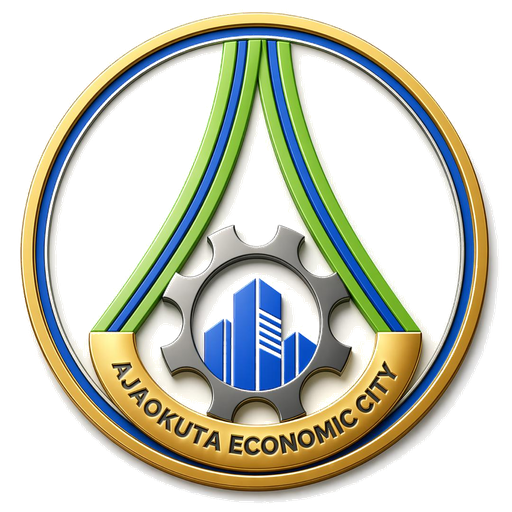
Ajaokuta Economic City — official seal
The official seal of Ajaokuta Economic City
The Seal

Four convergences. One city.

The AEC seal is composed deliberately. Every element corresponds to a foundational pillar of the economic city — agriculture, confluence, industry, and modern urban life — bound together within a gold medallion that signifies prestige, permanence, and state stewardship.

Green — agriculture

Kogi's vast arable land and the agro-allied industries that will feed AEC's processing clusters and export pipelines.

Blue — confluence

The historic meeting of the Niger and the Benue at Lokoja. A symbol of connectivity, trade, and AEC's role as a national gateway.

Steel gear — industry

Manufacturing, engineering, and the steel value chain that will power the city's productive economic engine.

Gold seal — stewardship

The medallion ring binds the elements together, signifying state stewardship, permanence, and AEC's status as a destination of national prestige.

Four pillars. One unfair advantage.

Every successful free zone in history — Shenzhen, Jebel Ali, Tanger Med — concentrated four ingredients. AEC is the first in Sub-Saharan Africa to combine them at scale, in the country with the largest consumer base on the continent.

01 / Location

The country's geographic centre

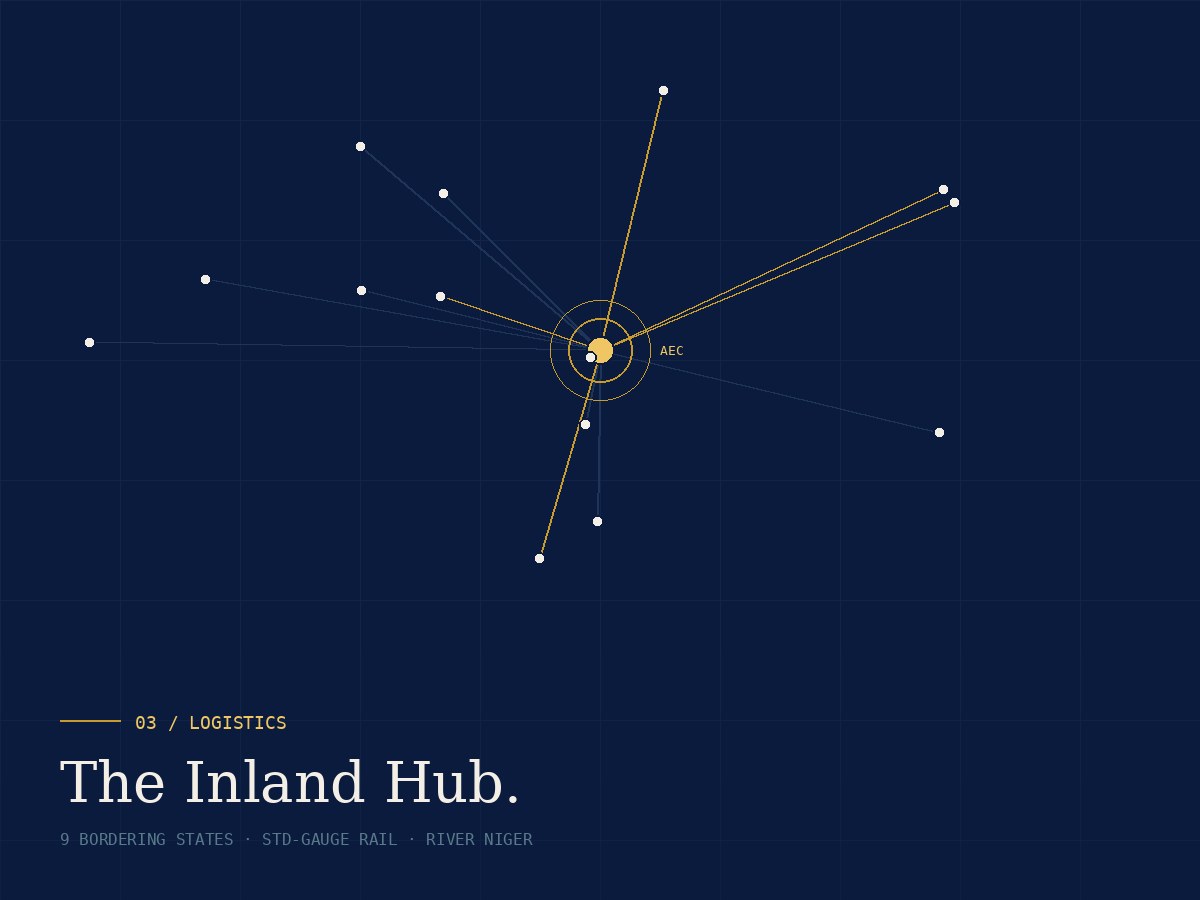
Kogi is the only Nigerian state bordering nine others — plus the Federal Capital Territory. Inland positioning bypasses Lagos port congestion; the Itakpe–Warri rail provides direct seaport access.

02 / Resource

Billions of tonnes in iron ore

Within 50 km: Itakpe iron ore deposits, Obajana limestone, Geregu power, and natural gas. The complete mineral feedstock for steel, cement and energy-intensive manufacturing is co-located.

03 / Market

1.4 billion AfCFTA consumers

Nigeria alone is 220 million people — the largest consumer market in Africa. Through AfCFTA, AEC tenants reach a continent-wide market under harmonised tariffs. Bordering states alone hold 47 million.

04 / Framework

NEPZA-backed free zone status

Full Free Trade Zone framework: tax holidays, 100% capital repatriation, duty-free imports, no foreign exchange restrictions, streamlined one-stop customs and immigration on-site.

AEC at a glance

The numbers behind the most strategically positioned industrial city in West Africa — sized, sequenced and capitalised for institutional investment-grade returns.

4,000ha
Land Bank
Larger than Jebel Ali's first phase. Sufficient for steel, manufacturing, agro, logistics, residential and reserve.
9states
Border Reach
Direct access to 47 million people in border states alone — before counting AfCFTA scale.
100k+
Direct Jobs
Phase 3 employment target: ~50–100k direct, ~80k indirect across the ecosystem.
$1.79bn
Net 20-yr Returns
Estimated cumulative net returns over the 20-year operating horizon at modelled occupancy.

The macro tailwind.

Nigeria's structural import dependency, a $878bn infrastructure deficit by 2040, AfCFTA market integration, and a deliberate federal pivot to non-oil exports converge on a single conclusion: industrial capacity, located inland, is the highest-leverage opportunity in Sub-Saharan Africa.

$65bn

Annual steel imports into Nigeria (2023)

Nigeria consumes 7–10 million tonnes of steel a year and produces less than 25% locally. Every percentage point of import substitution is hundreds of millions of dollars in domestic value capture.

220m

Domestic consumer market

The largest in Africa, with a median age of 17–18. A youth bulge that drives both labour supply and consumption demand for processed staples, packaged goods and durable manufactures.

75%

Of exports still tied to oil

Federal policy has shifted decisively toward non-oil export-led growth and the $1 trillion economy ambition by 2030. AEC is positioned as a flagship vehicle for that diversification.

17m

Housing-unit deficit

Combined with a near-vacant industrial base, this drives sustained, structural demand for steel rebar, cement, fittings, fixtures and downstream construction goods — exactly the AEC product mix.

Sectors. Selected for fit, not fashion.

Every priority sector at AEC is anchored on a verifiable Kogi State or Nigerian comparative advantage — not generic "innovation district" copy. Three primary clusters; seven multipliers.

Anchor · Tier A

Steel & Mining Value Chain

Nigeria imports up to $65bn of steel annually. AEC's mini-mill, DRI and finishing cluster is sized to capture meaningful import substitution, anchored on Itakpe iron ore and Geregu gas-fired power.

  • Mini-Mill
  • DRI
  • Long Steel
  • Flat Steel
  • Finishing
Anchor · Tier A

Agro-Processing & Agribusiness

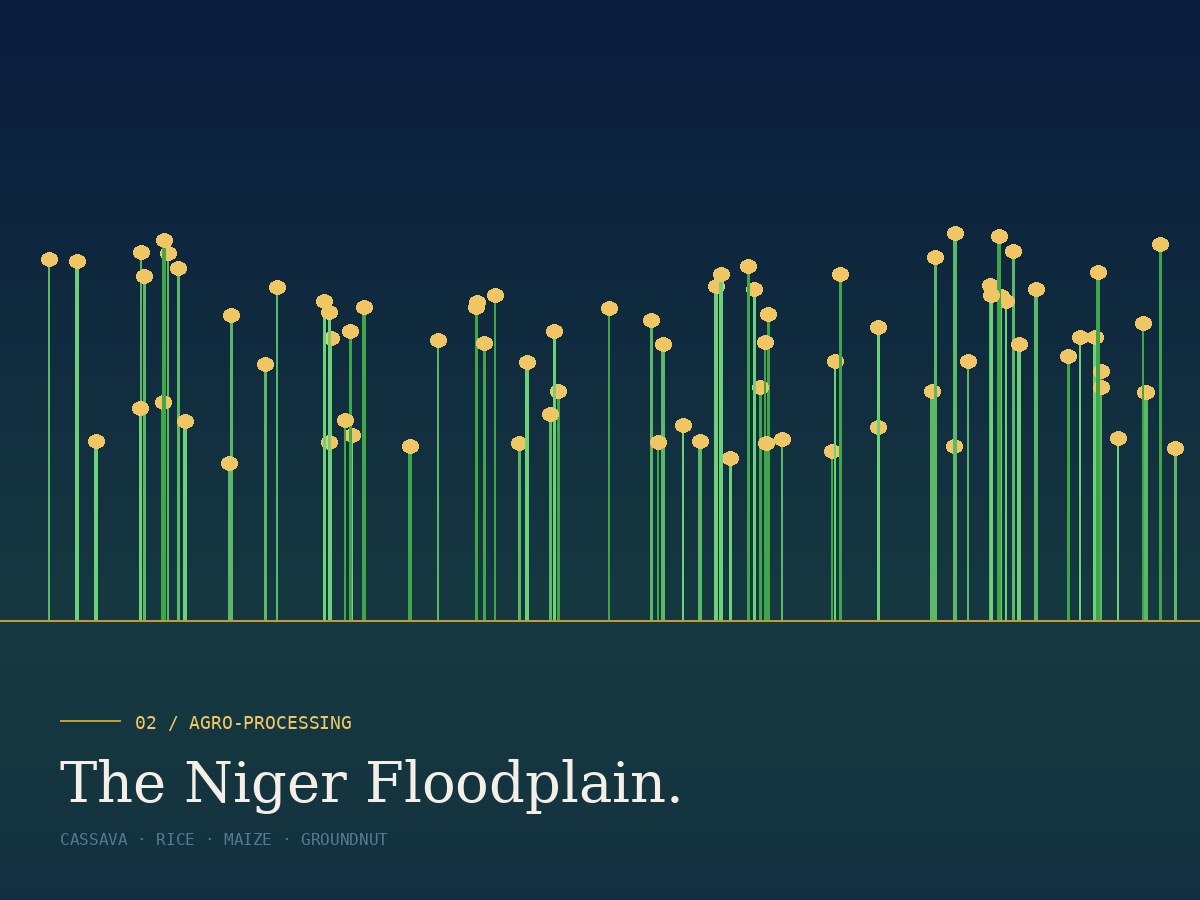
Cassava, rice, maize, groundnut, tomato — all locally grown at scale. AEC offers cold-chain corridors, packhouses, milling, edible-oil refining and export-grade compliance for AfCFTA reach.

  • Cassava Starch
  • Rice Milling
  • Tomato Paste
  • Edible Oils
  • Animal Feed
Anchor · Tier A

Logistics & Supply Chain

Inland container depot, dry port, bonded warehousing and rail-served freight yards. Decongest Lagos. Reduce time-to-market for nine bordering states. Offer 70–85% lower land cost than Lekki.

  • Dry Port
  • 3PL
  • Cold Chain
  • Bonded WH
  • E-commerce
Multiplier

Construction Materials

Driven by domestic steel, cement and a 17m-unit housing deficit. Obajana limestone within 50 km supplies cement and aggregates; West African construction boom expands the addressable market.

  • Cement
  • Aggregates
  • Tiles
  • Fittings
Multiplier

Pharmaceuticals

High-margin import-substitution opportunity in a 220-million-person health market. Logistics access, regulatory streamlining, and downstream linkages with packaging and cold chain.

  • Generics
  • API
  • Packaging
  • Cold Chain
Multiplier

Textiles & Garments

Leverages Nigeria's youthful workforce and AfCFTA preferential access. Vertical integration from cotton sourcing through finished garments suitable for regional and global export markets.

  • Spinning
  • Weaving
  • Apparel
  • Export
Multiplier

Agricultural Equipment

Mechanisation pipeline for Nigeria's dominant agrarian economy. Local manufacture, assembly and distribution serving domestic and ECOWAS markets through AfCFTA tariff advantages.

  • Tractors
  • Implements
  • Irrigation
  • Spares
Multiplier

Light & Heavy Manufacturing

Consumer goods, durables, components for vehicles and white goods. Plug-and-play industrial sheds, modular utility connections, and proximity to anchor steel and logistics tenants.

  • Consumer Goods
  • Components
  • Assembly
Multiplier

Technology & Innovation

Data centre node, fibre trunk corridors, R&D incubators co-located with industrial users. Industry 4.0 services for resident manufacturers; ICT outsourcing for regional clients.

  • Data Centre
  • R&D
  • BPO
  • Incubators
Multiplier

General Manufacturing & Assembly

Automotive sub-assembly, electronics, household goods. Targets the convergence of West African demand, low-cost competitive labour, and AfCFTA-enabled regional export pathways.

  • Automotive
  • Electronics
  • White Goods
The Site

Unosi. The confluence advantage.

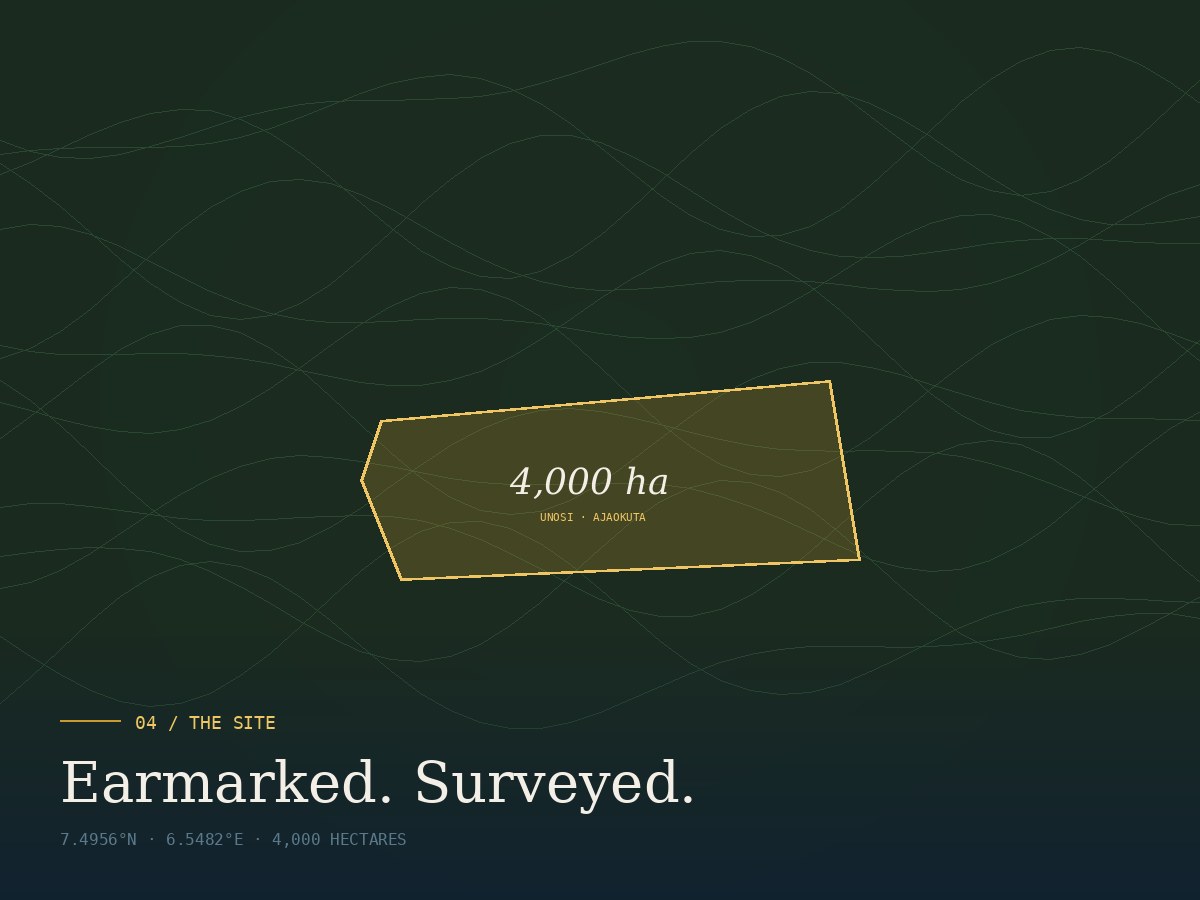
The site sits on gently rolling Niger–Benue floodplain at Unosi, Ajaokuta LGA. Lateritic high ground for engineered industrial platforms; alluvial lowlands for agro-plug farms and outgrower schemes. Year-round construction windows, predictable seasonal logistics.

Within a 50–100 km radius: Itakpe iron ore (NIOMCO), Obajana limestone (cement), Geregu gas-fired power, Obajana airstrip, Ajaokuta train station on the Itakpe–Warri standard-gauge line, and the River Niger.
  • Ajaokuta Steel Plant~ 6 kmHighway
  • Itakpe Iron Ore (NIOMCO)~ 35 kmHighway / Rail
  • Obajana Cement & Limestone~ 45 kmHighway
  • Lokoja (Capital)~ 42 kmHighway
  • Geregu Power Plant~ 48 kmGrid · PPA
  • River Niger~ 64 kmInland Waterway
  • Federal Capital, Abuja~ 195 kmHighway / Rail
  • Warri Seaport~ 342 kmStandard-Gauge Rail
  • Onne Seaport~ 415 kmHighway
  • Lagos / Lekki Ports~ 494 kmHighway / Rail
A ITAKPE Iron Ore LOKOJA Capital · Niger Confluence OBAJANA Limestone · Cement GEREGU Power Plant AJAOKUTA Steel Plant · Rail AEC · UNOSI 4,000 ha < 50 KM < 100 KM ITAKPE–WARRI STD. GAUGE RIVER NIGER N
Fig. 01 · AEC Site Opportunities Map · Not to Scale

The masterplan. Sequenced for capital.

A capital-efficient three-phase build-out anchored on early bankable returns. Anchor tenants commission alongside Phase-1 utilities, generating cashflow that de-risks subsequent expansion. Each phase has hard, measurable KPIs.

01
Phase One

Enable & Anchor

Years 0–3 · "Make it work"
  • Land & governance. SPV established. FTZ declared. Title consolidated.
  • Utilities (modular). 100–150 MW PPA with Geregu. 15,000 m³/day water plant. Telecom backbone.
  • Transport. Dual carriageway link, internal spine roads, rail spur right-of-way secured.
  • Anchor tenants. Mini-mill (0.5–1.0 Mtpa). Logistics operator. Agro-processing pilot. PPP clinic.
  • EPZ core. Customs & immigration on-site. Bonded warehousing operational.
  • KPI. Anchor LOIs signed. 50% logistics-park lease-up within 24 months.
02
Phase Two

Scale & Cluster

Years 3–7 · "Build density"
  • Utilities scale-up. Cumulative 250–400 MW. +25,000 m³/day water. Industrial wastewater.
  • Rail & port integration. Freight yard live. Block-train service to Warri/Onne. Long-term NRC SLA.
  • Industrial densification. +200 ha manufacturing. Rolling & finishing in steel cluster. 100–200 t/day agro lines.
  • EPZ & export services. Customs fast-lane operational. Forwarder hub.
  • Skills. TVET centre launched. Supplier development & local-content programme.
  • KPI. 15–30k direct jobs. Utility availability ≥ 75% to anchor tenants.
03
Phase Three

Maturity & City

Years 7–15 · "Realise scale"
  • Full utilities & redundancy. Looped HV grid. Captive renewables (solar + storage). Industrial-grade gas.
  • Maximised modal use. Regular block trains. Activated barge service via River Niger.
  • Industrial expansion. Downstream automotive, heavy machinery, advanced manufacturing.
  • Urban amenities. Hospital complex, university satellite campus, civic spaces.
  • Reserve commercialisation. 200 ha strategic reserve released for new sectors.
  • KPI. 50–100k+ direct jobs. >1–2 Mtpa aggregate steel. Positive net FX.
Spatial Allocation

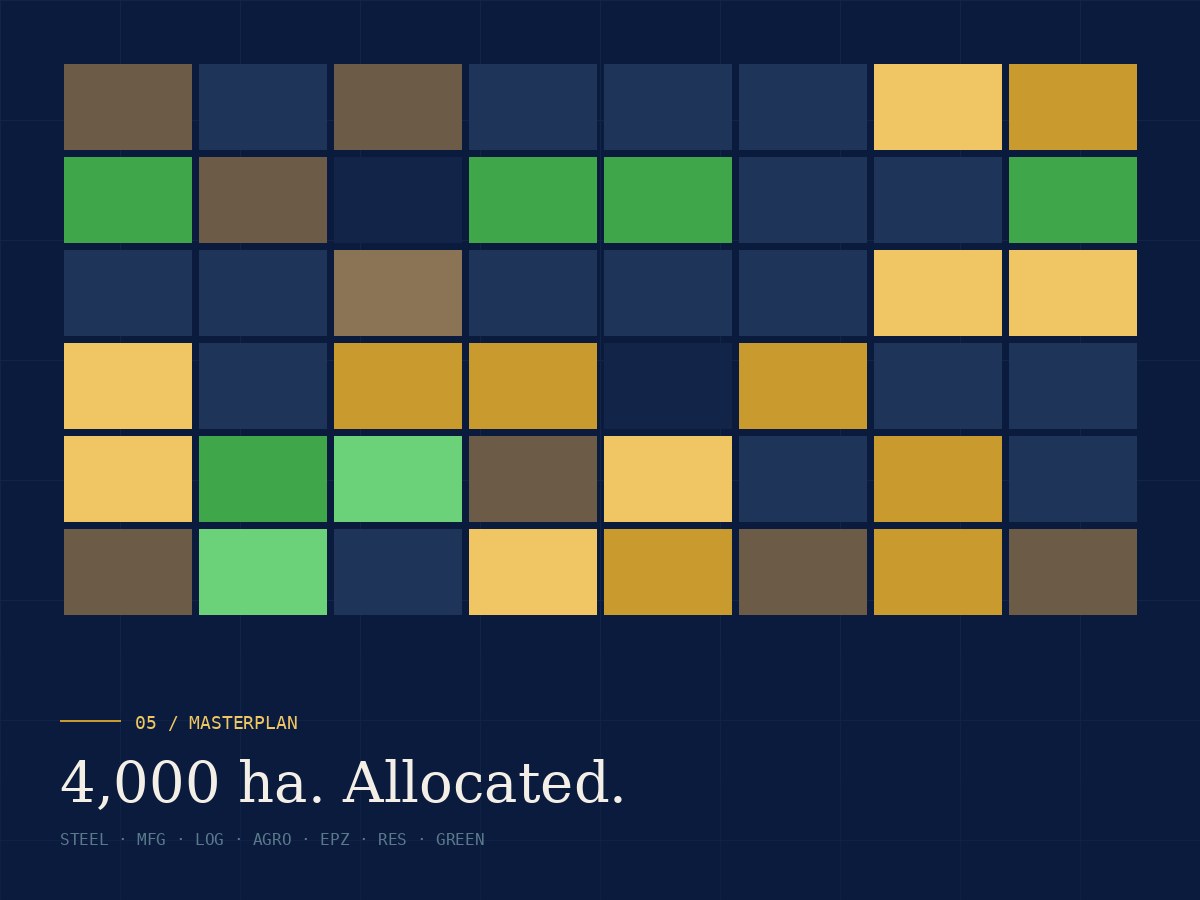
How the 4,000 hectares are deployed.

Total Site
4,000 ha
20% Steel
15% Mfg
15% Logistics
10% Agro
10% EPZ
15% Resi
5% Reserve
Heavy Industry / Steel Complex
800 ha
20.0%
Manufacturing (light/medium)
600 ha
15.0%
Logistics & Distribution + Rail Yard
600 ha
15.0%
Agro-Industrial Cluster
400 ha
10.0%
Export Processing Zone Core
400 ha
10.0%
Residential & Community
600 ha
15.0%
Technology & Innovation Park
150 ha
3.75%
Administrative & Commercial
100 ha
2.50%
Green Belts & Buffers
150 ha
3.75%
Strategic Reserve / Future
200 ha
5.0%

The numbers. Bluntly.

$1.3 billion of programmed CAPEX, sequenced across three phases, recovers in just over nine years and delivers a 178% project ROI over twenty. Modelled on conservative occupancy and benchmarked against comparable Nigerian FTZ growth profiles.

Total Capex
$1.3bn
Spread across two-year tranches. Includes road, water, sewerage, lighting, landscaping, security & preliminaries.
Payback Period
9.3yrs
Cumulative revenue exceeds total CAPEX in late Year 9, transitioning the project into permanent surplus.
Net Returns · 20yr
$1.79bn
Cumulative cashflow net of OPEX over the modelled twenty-year horizon at conservative occupancy.
Project ROI
178%
Modelled at recommended 70:30 equity-to-debt mix with concessional DFI financing and 9% cost of debt.
Revenue stack: land lease & rentals · licensing & registration fees · utilities pass-through · ancillary services · PPP ventures · immigration. Gross profit margin reaches 58.2% by Year 10. Revenue CAGR of 49.7% across the ramp phase (Y3–Y10), stabilising at 5% thereafter.

Projected revenue ramp ($M USD)

YearPhaseScale-UpAnnual Rev.CumulativeStatus
Y1–Y2Build-outConstruction
Y3Expansion30%$25.2$25.2Ramp
Y4Expansion60%$50.4$75.6Ramp
Y5Full Capacity100%$84.0$159.6Operating
Y6Growth+35%$113.4$273.0Operating
Y7Growth+35%$153.1$426.1Operating
Y8Growth+35%$206.7$632.8Operating
Y9Growth+35%$279.0$911.8Operating
Y10Growth+35%$376.7$1,288.4▶ Payback
Y11+Stabilised+5%$395.5+$1,683.9+Surplus
Y20Mature+5%$613.5$5,315.2Mature

Two ways in.

AEC is structured as a Special Purpose Vehicle with the Kogi State Government and host communities holding 30% equity (primarily through land contribution). The remaining 70% is open to a master development partner consortium and downstream Free Zone Enterprises.

For Master Developers

Co-develop the city itself.

We are seeking a development partner — or consortium of partners — to take the lead on infrastructure delivery, utilities, capital raise, and master tenant attraction. Equity participation, BOT/PPP, or hybrid structures are all on the table.

  • Up to 70% equity participation (private/DFI)
  • $1.3bn programmed CAPEX over phased build-out
  • Land bank contribution from State (20%) and Community (10%)
  • NEPZA Free Zone declaration secured
  • Pathway: concessional DFI debt + infrastructure bonds + sovereign support
  • WACC modelled at ~13%; project IRR materially above hurdle
Open Partnership Conversation
For Free Zone Enterprises

Locate inside the fastest-onboarding zone in Nigeria.

Anchor tenants and growth-stage manufacturers locating in AEC benefit from plug-and-play serviced plots, customs & immigration on-site, and graded land-lease incentives for early commitments. Our One-Stop-Shop is designed for ≤90-day approval.

  • Plug-and-play serviced plots from Phase 1
  • Long-term indexed PPAs and dedicated water allocation
  • Bonded warehousing & expedited customs from day one
  • Full FTZ incentives: tax holidays · capital repatriation · duty-free imports
  • Anchor incentives: graded lease discounts & CAPEX co-investment on shared corridors
  • One-Stop-Shop targeting ≤ 90-day full approval cycle
See Set-Up Process

The incentives.

AEC operates under Nigeria's NEPZA Free Trade Zone framework — among the most competitive in Sub-Saharan Africa — augmented with state-level fiscal and operational support specific to AEC tenants.

Fiscal · 01

Federal & State Tax Holiday

Full federal company income tax holiday. Exemption from state & local government taxes, levies and rates within the zone.

Fiscal · 02

Duty-Free Imports

Free import of capital goods, raw materials, machinery, components, consumables — no foreign exchange controls on imports for zone enterprises.

Fiscal · 03

100% Capital Repatriation

Free repatriation of capital, profits and dividends. No restrictions on foreign equity holding — 100% foreign ownership permitted.

Operational · 04

One-Stop Approval

Customs, immigration, NEPZA, FMITI and all utility connections coordinated through a single AEC service window.

Operational · 05

Plug-and-Play Plots

Pre-serviced industrial plots with road, power, water, fibre and drainage at the boundary. Optional pre-built warehousing.

Strategic · 06

AfCFTA Market Access

Nigeria's AfCFTA membership gives AEC enterprises preferential access to a 1.4 billion-person continental market under harmonised tariffs.

Strategic · 07

Anchor Tenant Incentives

Graded land-lease discounts, indexed long-term PPAs, and CAPEX co-investment on shared utility corridors for early anchor commitments.

Strategic · 08

Local Content & TVET

State-supported supplier development and a dedicated technical-vocational training centre delivering skilled labour to resident tenants.

Strategic · 09

30-Year Lease Tenure

Renewable long-term land lease with attractive base rates and security of tenure aligned with NEPZA standards.

Setting up at AEC. In ninety days.

From first contact to operating licence, AEC's One-Stop-Shop is designed to minimise time-to-revenue for resident enterprises. The full sequence below is the indicative pathway for a Free Zone Enterprise.

01

Expression of Interest

Submit project profile, business plan summary, sector and indicative land/built-up requirement via the AEC portal.
Day 1
02

Site Visit & Pre-Engagement

Guided site walk, infrastructure briefing, utility allocation discussion, and meeting with AEC commercial team.
Days 5–10
03

Letter of Intent & Term Sheet

AEC issues commercial term sheet (lease rate, plot, utilities, incentives). Investor confirms intent.
Days 10–25
04

NEPZA Operating Licence

Free Zone Enterprise application, due diligence, and operating licence — coordinated by AEC's regulatory liaison.
Days 25–55
05

Lease Execution & Plot Handover

Long-term land lease executed; plot handed over with utilities at the boundary; design submission begins.
Days 55–75
06

Construction Permit & Mobilisation

Building control consent issued by AEC building authority. Contractor mobilisation; on-site security & HSE briefing.
Days 75–90
07

Commissioning & Operations

Utility connections live. Customs & immigration onboarding for staff. Bonded warehousing access. First production run.
Months 6–18

News, briefings & press. From the agency.

Official announcements from the Kogi State Investment Promotion & PPP Agency, milestone updates on AEC's development, and selected coverage of Nigeria's next industrial destination.

Featured · Uncategorized

Hello world!

Welcome to WordPress. This is your first post. Edit or delete it, then start writing!

Read the full release

Frequently asked. Plainly answered.

A short, honest catalogue of the questions investors and partners are most likely to raise. For anything not covered here, our team is one form away.

AEC is delivered through a Special Purpose Vehicle. Indicative ownership: 70% private & DFI equity/debt; 20% Kogi State (primarily land & regulatory contribution); 10% host communities. Governance flows through a Project Steering Committee chaired by the State, with NEPZA, NIPC and the Private Management Partner as core members.

Yes. Kogi State has earmarked 4,000 hectares at Unosi, along the Ajaokuta–Okene Expressway near the Railway Bridge in Ajaokuta LGA. Title consolidation, community engagement and the Resettlement Action Plan (RAP) — aligned to IFC Performance Standards — are part of Phase 1 governance work.

Phase 1 uses a negotiated PPA tranche of 100–150 MW from the Geregu power plant, supplemented by captive gas-fired generation and high-efficiency backup. Phase 2 scales to a cumulative 250–400 MW. Phase 3 integrates renewables (solar + battery storage) and looped HV redundancy.

The site is on the Ajaokuta–Itakpe–Lokoja highway with direct access to the Itakpe–Warri standard-gauge railway (commissioned 2020), connecting AEC to Warri seaport (~342 km) and Onne (~415 km). The masterplan reserves a rail spur and freight-yard right-of-way from Phase 1. River Niger access provides long-term multimodal upside.

Full NEPZA Free Trade Zone benefits: federal tax holiday, exemption from state & local taxes, duty-free import of capital goods and raw materials, 100% capital and profit repatriation, no foreign-exchange restrictions on zone activity, 100% foreign ownership permitted, and one-stop customs & immigration on-site.

The AEC One-Stop-Shop targets a 90-day cycle from Expression of Interest to Construction Permit & Mobilisation for standard FZ Enterprise applications. Larger anchor tenants and master-developer-scale agreements follow a parallel, customised path with the Project Steering Committee.

Risks have been mapped across Viability, Engineering and Operational phases per ISO 31000 and World Bank standards, with RAG ratings, probability/impact scoring, designated owners and mitigation pathways. Critical risks (utilities, off-site access, anchor commitment) are addressed through early MoUs, modular phasing, and pre-commitment of anchor tenants before Phase 1 build-out.

Yes. A full Social Impact Assessment (SIA) and Environmental Impact Assessment (EIA) are integral to the project, aligned with World Bank, IFC Performance Standards and Nigeria's EIA Act. The framework covers Resettlement Action Plans, livelihood restoration, gender & vulnerable-group inclusion, GBV prevention, cultural-heritage mapping, and an embedded HSE programme.

Get In Touch

Begin the conversation.

Whether you are a development partner sizing up a $1.3bn flagship opportunity, an industrial group seeking inland West African production capacity, or a multilateral DFI looking for an institutional-grade greenfield, we'd like to hear from you.

Office
Kogi State Investment Promotion &
Public-Private Partnership Agency
Lokoja, Kogi State, Nigeria
Email
Direct
Coordinates
7.4956°N · 6.5482°E
Investor Enquiry

Tell us who you are.